Functional study of PAP3/pTAC10 in the plastid-encoded RNA polymerase during chloroplast biogenesis
DOI:
https://doi.org/10.24193/subbbiol.2026.1.04Keywords:
chloroplast biogenesis, PAP3, photobodies, phytochrome B, plastid-encoded RNA polymeraseAbstract
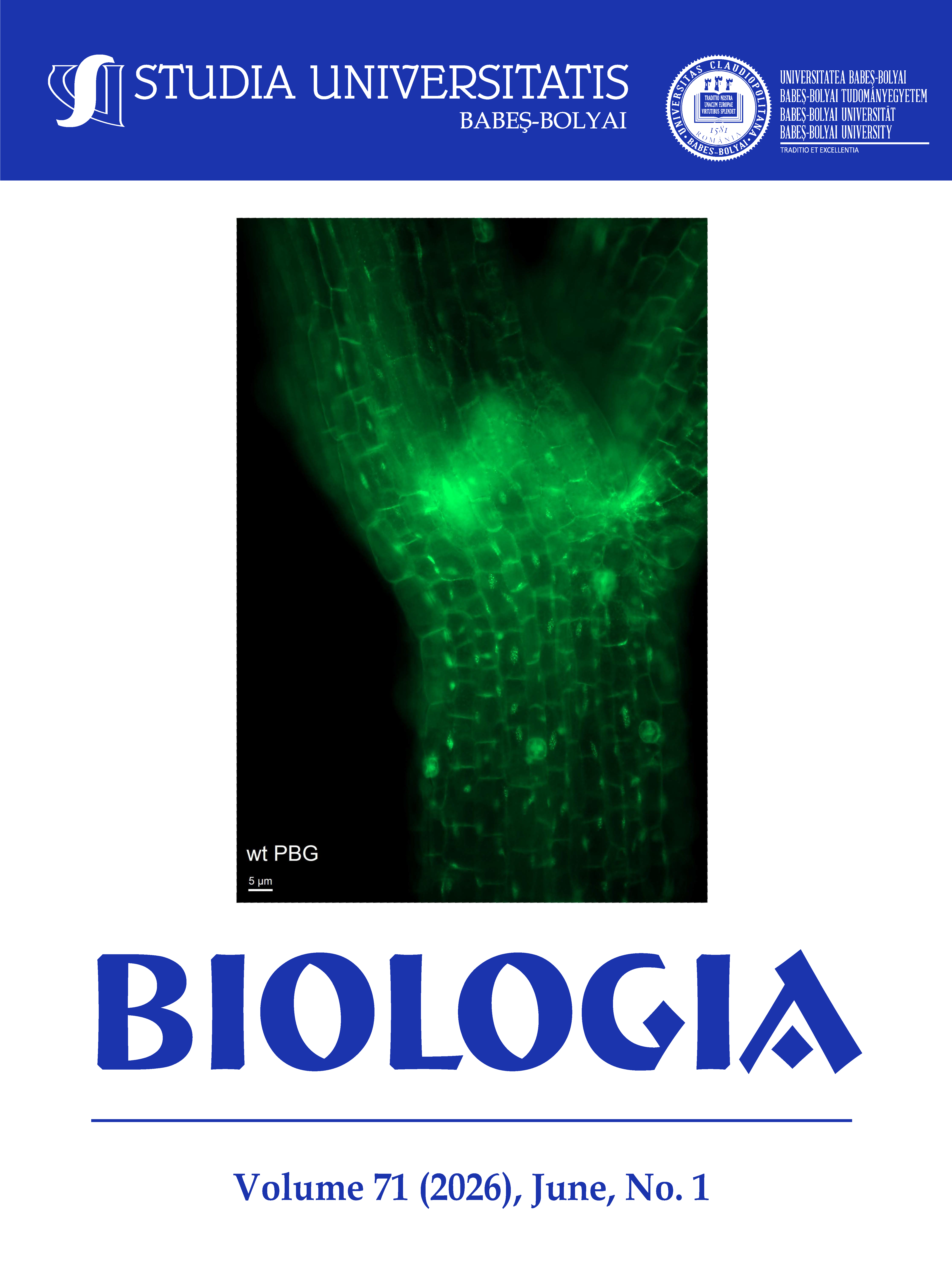
Chloroplast biogenesis in angiosperms depends on two types of RNA polymerases: the nuclear-encoded RNA polymerase (NEP) and the plastid-encoded RNA polymerase (PEP). PEP, in its active form (PEP-A), is supported by multiple nuclear-encoded proteins called PEP-associated proteins (PAPs). Among these, PAP3 (also known as pTAC10) plays a structural role in the PEP complex. Epifluorescent microscopy was used in order to verify its localization, confirming that PAP3 has a single subcellular localization: the chloroplast. Using the Arabidopsis thaliana pap3-1 mutant and PHYB-GFP (PBG) reporter lines, we demonstrate that PAP3 is not required for PHYB-mediated light signaling pathway nor for photobody formation. Contrary to PAP8, whose loss of function affects red light signaling and photobody formation, pap3 mutants show normal hypocotyl de-etiolation and photobody assembly under red light. These results suggest that in contrast with the nucleo-chloroplastic PAP8, PAP3 is confined to the plastid compartment and that it contributes exclusively to the plastidial transcriptional machinery. The difference in behavior between pap8 and pap3 mutants implements the existence of two distinct albino syndromes in PAPs, depending on their localization: dually localized (nucleus and chloroplasts) or solely localized (chloroplasts).
Article history: Received 30 July 2025; Revised 24 February 2026;
Accepted 30 April 2026; Available online 25 June 2026.
References
Archibald, J. M. (2015). Endosymbiosis and eukaryotic cell evolution. Current Biology, 25(19), R911–R921. https://doi.org/10.1016/j.cub.2015.07.055
Bock, R., & Timmis, J. N. (2008). Reconstructing evolution: Gene transfer from plastids to the nucleus. BioEssays, 30(6), 556–566. https://doi.org/10.1002/bies.20761
Börner, T., Aleynikova, A. Y., Zubo, Y. O., & Kusnetsov, V. V. (2015). Chloroplast RNA polymerases: Role in chloroplast biogenesis. Biochimica et Biophysica Acta (BBA) - Bioenergetics, 1847(9), 761–769. https://doi.org/10.1016/j.bbabio.2015.02.004
Cappadocia, L., Maréchal, A., Parent, J.-S., Lepage, étienne, Sygusch, J., & Brisson, N. (2010). Crystal Structures of DNA-Whirly Complexes and Their Role in Arabidopsis Organelle Genome Repair. The Plant Cell, 22(6), 1849–1867. https://doi.org/10.1105/tpc.109.071399
Chan, C. X. & Bhattacharya, D. (2010). The Origin of Plastids. Nature Education 3(9):84.
Chen, M., Galvão, R. M., Li, M., Burger, B., Bugea, J., Bolado, J., & Chory, J. (2010). Arabidopsis HEMERA/pTAC12 initiates photomorphogenesis by phytochromes. Cell, 141(7), 1230–1240. https://doi.org/10.1016/j.cell.2010.05.007
Chen, M., Schwab, R., & Chory, J. (2003). Characterization of the requirements for localization of phytochrome B to nuclear bodies. Proceedings of the National Academy of Sciences, 100(24), 14493–14498. https://doi.org/10.1073/pnas.1935989100
Choi, H., Yi, T., & Ha, S.-H. (2021). Diversity of plastid types and their interconversions. Frontiers in Plant Science, 12. https://doi.org/10.3389/fpls.2021.692024
Huang, H., Yoo, C. Y., Bindbeutel, R., Goldsworthy, J., Tielking, A., Alvarez, S., Naldrett, M. J., Evans, B. S., Chen, M., & Nusinow, D. A. (2016). PCH1 integrates circadian and light-signaling pathways to control photoperiod-responsive growth in Arabidopsis. eLife, 5, e13292. https://doi.org/10.7554/eLife.13292
Kindgren, P., & Strand, Å. (2015). Chloroplast transcription, untangling the Gordian Knot. New Phytologist, 206(3), 889–891. https://doi.org/10.1111/nph.13388
Liebers, M., Cozzi, C., Uecker, F., Chambon, L., Blanvillain, R., & Pfannschmidt, T. (2022). Biogenic signals from plastids and their role in chloroplast development. Journal of Experimental Botany, 73(21), 7105–7125. https://doi.org/10.1093/jxb/erac344
Liebers, M., Gillet, F., Israel, A., Pounot, K., Chambon, L., Chieb, M., Chevalier, F., Ruedas, R., Favier, A., Gans, P., Boeri Erba, E., Cobessi, D., Pfannschmidt, T., & Blanvillain, R. (2020). Nucleo‐plastidic PAP8/pTAC6 couples chloroplast formation with photomorphogenesis. The EMBO Journal, 39(22), e104941. https://doi.org/10.15252/embj.2020104941
Pfannschmidt, T., Ogrzewalla, K., Baginsky, S., Sickmann, A., Meyer, H. E., & Link, G. (2000). The multisubunit chloroplast RNA polymerase A from mustard (Sinapis alba). European Journal of Biochemistry, 267(1), 253–261. https://doi.org/10.1046/j.1432-1327.2000.00991.x
Steiner, S., Schröter, Y., Pfalz, J., & Pfannschmidt, T. (2011). Identification of essential subunits in the plastid-encoded RNA polymerase complex reveals building blocks for proper plastid development1[C][W][OA]. Plant Physiology, 157(3), 1043–1055. https://doi.org/10.1104/pp.111.184515
Yoo, C. Y., Williams, D., & Chen, M. (2019). Quantitative analysis of photobodies. In A. Hiltbrunner (Ed.), Phytochromes (Vol. 2026, pp. 135–141). Springer New York. https://doi.org/10.1007/978-1-4939-9612-4_10
Downloads
Published
License
Copyright (c) 2026 Studia Universitatis Babeş-Bolyai Biologia

This work is licensed under a Creative Commons Attribution-NonCommercial-NoDerivatives 4.0 International License.


 This work is licensed under a